How Much Exercise Does a American Pit Bull Terrier Need? Plus Brain Games
General training information. Every dog is an individual; for health or behavior concerns, see your veterinarian.
If you live with an American Pit Bull Terrier, you already know the look. It is the stare that says the walk was nice, but now what? This breed was built to work, and a bored dog with a strong body will invent its own job.
This guide walks you through setting up a daily plan for American Pit Bull Terrier exercise, step by step. It also covers American Pit Bull Terrier mental stimulation, because a tired body and a tired brain are two different things. You need both.
What the Breed Standard Says About Activity
The question of how much exercise an American Pit Bull Terrier needs does not have one official number. The United Kennel Club (UKC) breed standard describes a physically active, muscular and very agile dog, but it does not give an exercise amount.
A Chewy breed profile, which is a retailer page and not a breed club or a veterinary source, suggests about 1 to 2 hours of intense activity a day. Treat that as a loose starting range, not a rule. Individual dogs vary a lot, and age, health and fitness change the answer.
The UKC also explains where this energy comes from. It says the breed was developed in England, Ireland and Scotland from Bulldog and Terrier crosses. Its original jobs included catching semi-wild cattle and hogs, hunting, driving livestock, and serving as a family companion. That is a lot of running, grabbing, tracking and thinking. It makes sense that a pet dog with no outlet gets restless.
Your veterinarian is the right person to confirm a safe amount for your dog's age, weight and joints. The breed sources do not give puppy or senior exercise limits, so I will not invent any.
Materials You Will Need
- A well-fitted harness or flat collar and a sturdy 6 foot leash
- A long line (15 to 30 feet) for sniffing practice in open areas
- A treat pouch and small, soft, pea-sized treats
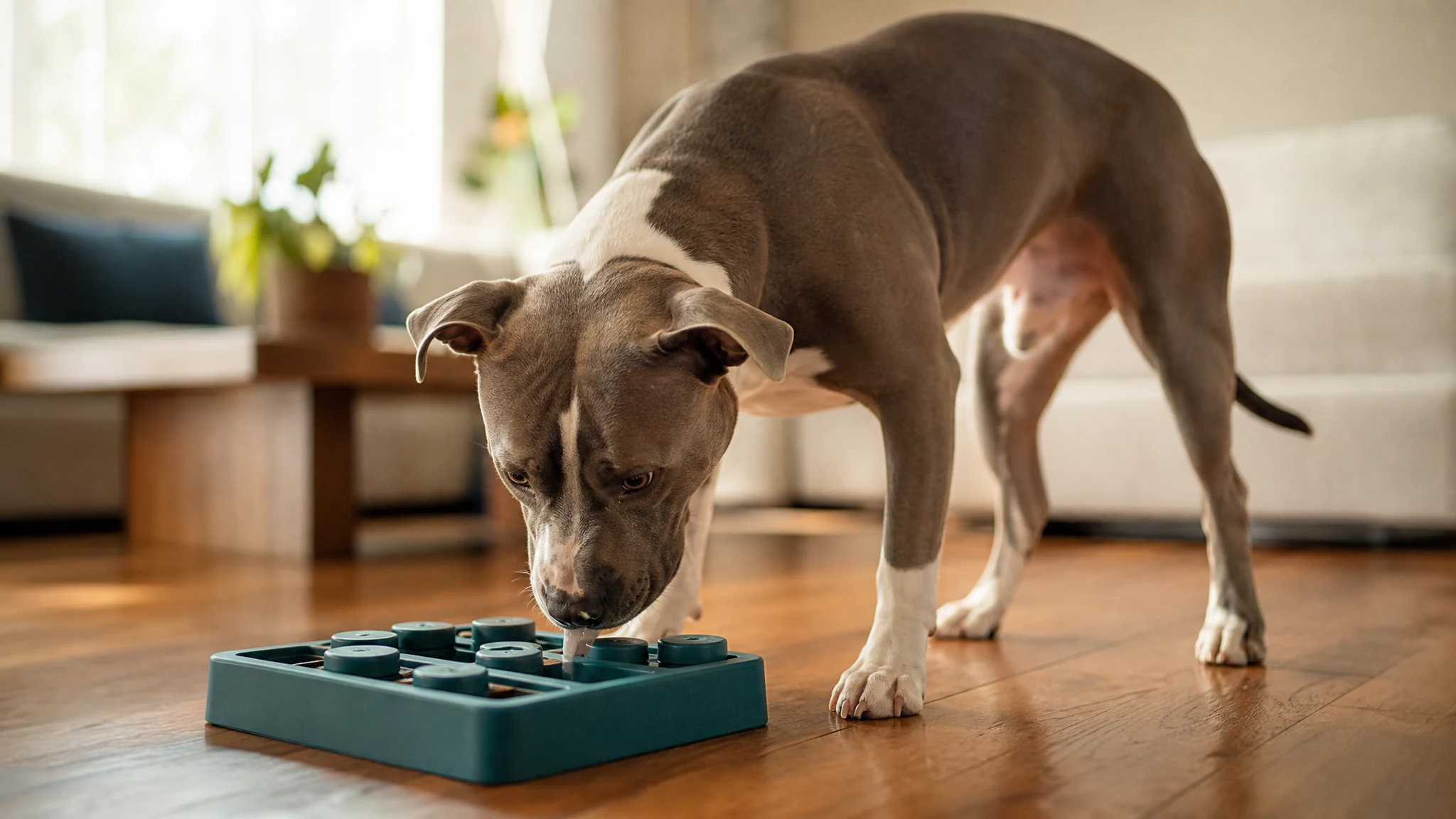
- A puzzle feeder, snuffle mat or lick mat
- A flirt pole or a toy on a rope (optional)
- Cardboard boxes, towels and a muffin tin for homemade games
- A securely fenced yard, if you have one
- A water bottle and a collapsible bowl
Step-by-Step: Build a Daily Exercise and Brain Plan
Step 1: Start with a vet check and a baseline
Before you raise the activity level, ask your veterinarian whether your dog is fit for it. This matters most for puppies, seniors, overweight dogs and any dog that limps or tires quickly.
The Chewy profile describes hip dysplasia as common in bully breeds and says it can lead to arthritis. That is a secondary source, so use it only as a reason to ask your vet about your own dog's hips and joints. Do not try to diagnose anything at home.
Then write down what your dog does now. Note how long walks last, how your dog behaves afterward, and when it gets restless. You will compare against this later.
Step 2: Set a flexible daily target
For a healthy adult, think of the day as two or three sessions instead of one big workout. A morning walk, a midday play or training session, and an evening outing is easier on you and easier on the dog than a single marathon.
Use the Chewy range of 1 to 2 hours of active time as a loose ceiling to work toward, and build up slowly if your dog is out of shape. Count training games and sniff walks as part of that time, not extra on top of it.
Step 3: Adjust for life stage
Puppies. The sources I rely on do not give a puppy exercise limit or joint-care guidance for this breed. Ask your veterinarian how much running, jumping and stair work is right for your puppy's growth stage. In the meantime, favor short, calm sessions, soft surfaces and lots of play over long forced runs.
A puppy's best work is learning. An article from the American Dog Breeders Association (ADBA) says the key socialization window runs from eight weeks to six months of age, and that calm early exposure builds confidence. Short outings to see new things, with treats and no pressure, count as exercise and as education.
Adults. Healthy adults can usually handle the full plan in this guide, built up gradually. The UKC lists sports for the breed that include Agility, Dock Jumping, Weight Pulls, Tracking and Obedience, so many adults enjoy structured activity if their vet agrees.
Seniors. Chewy lists a typical life span of 12 to 14 years, though the UKC page does not state one. As your dog ages, shorten the hard sessions and keep the brain games going. Sniffing and puzzle work are gentle on joints. Your vet can tell you when to change the plan.
Step 4: Make at least one walk a sniff walk
A sniff walk is simple. Pick a safe route, clip on a long line or a loose leash, and let your dog choose where to stop and investigate. You are not going anywhere in a hurry.
- Choose a quiet spot with plenty of grass, bushes or leaf litter.
- Say a release cue such as "go sniff" and let the lead go slack.
- Stand still while your dog explores. Do not pull.
- After a few minutes, call your dog back with a happy voice and reward with a treat.
- Repeat for 15 to 30 minutes.
Many dogs finish a sniff walk calmer than a fast walk of the same length. Results vary, and you may see the benefit in a few weeks of regular practice.
Step 5: Feed some meals from puzzles
Instead of a bowl, serve part of your dog's daily food in a puzzle feeder, snuffle mat or lick mat. Start with an easy setup so your dog wins quickly. Raise the difficulty only after it solves the easy version.
A homemade version works too. Place kibble in the cups of a muffin tin and cover each with a tennis ball. Or scatter food across the grass and let your dog hunt for it. Always keep these treats within your dog's normal daily food amount, and ask your vet about portions.
Step 6: Add games that match the breed's original job
The UKC says the breed was used as a catch dog, a hunting companion and a livestock driver. You do not need hogs to give your dog a similar kind of work. These games use the same instincts in safe ways.
- Find it (tracking and hunting). Hide treats around a room, then the yard. Let your dog use its nose. Tracking is one of the sports the UKC lists for the breed.
- Flirt pole (chase and catch). Drag a toy on a rope in low, fast arcs along the ground, then let your dog catch it. Keep sessions short, ask for a sit before each chase, and always let your dog win in the end. Lure Coursing is also on the UKC list of breed sports.
- Tug with rules (grip and pull). Teach "take it" and "drop it." Pause the game if your dog's mouth touches your hand. Weight Pulls are listed by the UKC, and the ADBA runs weight pulls with Ace and Ace of Ace titles. Any real pulling work should wait until your vet agrees your dog is fit and fully grown.
- Box shuffle (problem solving). Put treats in a few open boxes, then add towels and crumpled paper to make it harder.
- Short obedience drills (driving and handler focus). Two to five minutes of sit, down, stay and recall with treats tires the brain quickly. Obedience and Rally Obedience are both UKC sports.
Step 7: Plan safe off-leash and dog-to-dog time
The UKC standard states that most American Pit Bull Terriers show some level of dog aggression. It also says the breed needs an owner who carefully socializes and obedience trains it. Individual dogs vary, but plan as if your dog may not enjoy every other dog.
That affects how you exercise. Crowded dog parks are a gamble. Safer options include leashed walks with a calm, known dog, one-on-one play dates you have arranged ahead of time, and solo activities such as flirt pole work and scent games. If your dog reacts to other dogs, talk with a reward-based trainer for help.
The UKC also notes the breed is a strong climber, so secure fencing is needed. Check your fence height and look for anything your dog could use as a step. A long line on a lead is a safer way to give freedom in open spaces without a fence.
Step 8: Add some training time to every day
The UKC describes the breed as eager to please and notes its strength, confidence and zest for life. An ADBA article quotes a behaviorist praising the breed's trainability. Use that eagerness. Reward-based training is also in line with American Veterinary Society of Animal Behavior (AVSAB) guidance.
Work short sessions into the day, such as 5 minutes before breakfast or while the kettle boils. For a fuller plan covering manners, recall and socialization, read our complete American Pit Bull Terrier training guide.
Step 9: Watch your dog and adjust
After two weeks, compare your dog's behavior to your baseline from Step 1. Does it settle after sessions? Does it chew less, or pace less in the evening? Adjust one thing at a time.
Signs you may be doing too much include heavy limping, reluctance to move the next day, or lagging behind on walks. If you see those, rest your dog and call your vet. Signs you may be doing too little include destructive chewing, nonstop pacing and bouncing off the walls at bedtime. Add a brain game before adding more miles.
A Sample Day
| Time | Activity | Type |
|---|---|---|
| Morning | Leashed walk, 20 to 30 minutes, with a few sniff stops | Body and nose |
| Breakfast | Part of the meal in a puzzle feeder | Brain |
| Midday | 5 minutes of obedience drills, then find it | Brain and nose |
| Late afternoon | Flirt pole or tug session, 10 minutes, with rules | Body and impulse control |
| Evening | Sniff walk, 20 to 30 minutes | Body, nose and calm |
| Night | Lick mat or a chew approved by your vet | Settling |
Treat this as a template, not a prescription. Swap in what your dog enjoys and what your schedule allows.
Tips for Success
- Mix it up. Rotate games across the week so your dog does not get bored.
- Quit while your dog is still keen. A short, happy session beats a long, frustrating one.
- Use a calm "settle" routine after exciting play, so your dog learns to switch off.
- Keep fresh water on hand, and rest in the shade on warm days.
- Always supervise toys, puzzle feeders and chews.
- Reward good choices generously. Humane, reward-based methods keep the work fun.
Common Mistakes to Avoid
- Only running the dog. More miles can build stamina without making a dog calmer. Add brain work.
- Skipping the vet check. Joint and fitness problems are easy to miss until they get worse.
- Overdoing it with a puppy. Long, hard runs and repeated jumping are not a good idea while a puppy is growing. Ask your vet for limits.
- Trusting the dog park. With a breed where most dogs show some dog aggression, according to the UKC, a busy off-leash space is a risk.
- Relying on the fence. A strong climber can clear a low or poorly built fence.
- Using harsh corrections. Shock, prong and choke collars, scruffing and dominance tactics do not belong in training. They can damage trust and create new problems.
- Making every game a contest. Keep tug and chase games structured so excitement does not turn into frustration.
What to Expect
With steady practice, many owners find their dog settles more easily at home, and may chew and pace less. Sniff walks and puzzle meals often help a dog wind down, but every dog is different, and results depend on age, health, temperament and consistency.
Give any new routine at least two to four weeks before judging it. If your dog still seems restless, anxious or unwell, check with your veterinarian first, then consider a reward-based trainer for help with behavior.
Quick Answers
Is a long daily run enough for this breed?
Probably not by itself. The UKC describes an agile, athletic dog bred for working jobs. Mixing physical activity with scent work, puzzles and short training sessions usually covers more needs than running alone.
Can I do dog sports with my American Pit Bull Terrier?
The UKC lists Obedience, Rally Obedience, Tracking, Agility, Lure Coursing, Dock Jumping, Weight Pulls and Conformation. The ADBA runs conformation shows and weight pulls. Check each organization for current rules, and get your vet's approval before starting any physical sport.
How do I know the right amount for my own dog?
Ask your veterinarian, watch your dog's energy and recovery, and adjust slowly. No breed source gives a single correct number.