Leash Training a American Pit Bull Terrier: Pulling, Lunging and Loose-Leash Walking
General training information. Every dog is an individual; for health or behavior concerns, see your veterinarian.
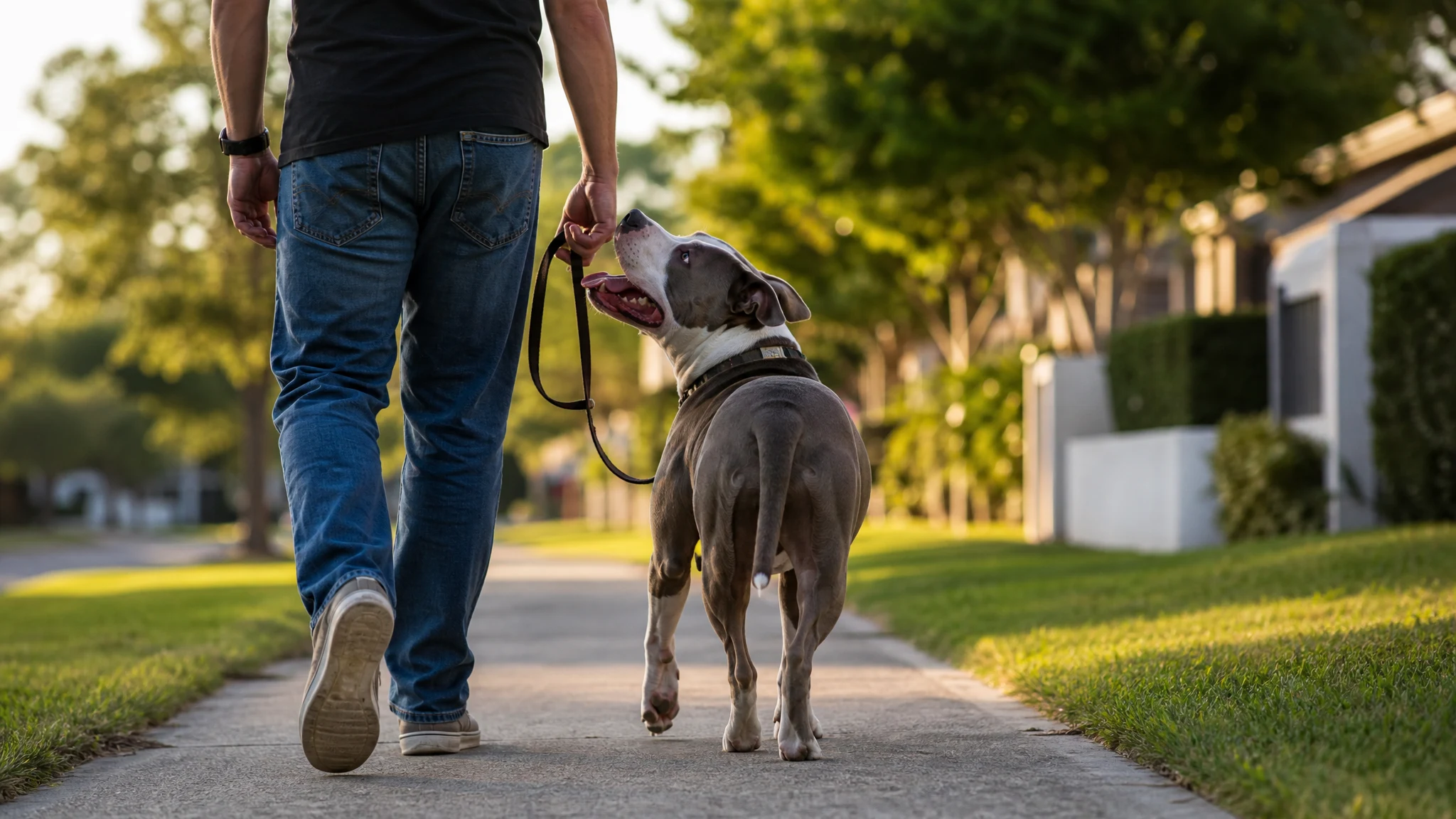
Walking an American Pit Bull Terrier should feel like a team outing. For many owners it feels like water skiing. The dog hits the end of the leash, your shoulder complains, and every squirrel becomes a crisis.
This is fixable. It takes patience, good timing and a lot of small rewards. Below you will find why the breed pulls, what gear to use, a step-by-step plan for loose-leash walking, and a calm way to handle lunging.
Individual dogs vary, so treat this as a framework and adjust to the dog in front of you.
Why this breed pulls
Pulling is not stubbornness or disrespect. Dogs pull because it works. Every time the leash is tight and you follow, the dog learns that tension gets it where it wants to go.
The breed adds a few extra reasons. The United Kennel Club (UKC) breed standard describes the American Pit Bull Terrier as physically active, muscular and very agile, with strength, confidence and a zest for life. That is a lot of engine attached to a leash.
The UKC also notes the breed's working roots. It was developed as a catch dog for semi-wild cattle and hogs, and used for hunting and driving livestock. A dog from that background is built to move toward things with purpose. That does not mean your dog will act on any one instinct, but it helps explain why a squirrel, a scent or a bouncing ball can pull so hard.
Size matters too. The UKC standard lists mature males at 35 to 60 pounds and mature females at 30 to 50 pounds. A dog in that range with a strong build can pull a person off balance, so good habits matter early.
The good news from the same standard is that the breed is described as eager to please. That is the lever you pull in training. Reward the behavior you want, often, and the dog has a reason to keep choosing it.
Materials you need
Keep the kit simple.
- A flat collar that fits snugly, with room for two fingers underneath, carrying ID tags.
- A front-clip harness with the leash ring on the chest. When the dog surges forward, the ring turns the dog gently toward you instead of letting it lean into the pull. Fit it so it does not rub under the legs.
- A standard 6-foot leash. Choose a fixed-length leash with a comfortable grip. Skip retractable leashes for training, because they teach the dog that pulling extends the walk.
- A treat pouch filled with small, soft, smelly treats. Pea-sized pieces work best so the dog can eat quickly and keep moving.
- A quiet place to start, such as a hallway, garage or fenced yard.
We do not use prong collars, choke collars or shock collars. Reward-based training, in line with the American Veterinary Society of Animal Behavior (AVSAB), gives you a dog who walks nicely because it wants to, not because it is afraid of what happens when it does not. Pain-based tools can also make a dog link the pain with whatever it was looking at, which is a poor deal when that is another dog or a stranger.
Step-by-step: how to leash train an American Pit Bull Terrier
1. Make the gear a good thing
Before any walking, clip the leash on indoors, feed a few treats, then take it off. Repeat a few times. The harness and leash should predict good things, not the start of a tug-of-war.
2. Teach the dog where the reward zone is
Pick a side, left or right, and stick with it. Stand still with the dog beside you. Drop a treat at your side by your leg. Repeat ten or fifteen times. The dog soon learns that the spot next to you is where good things appear.
3. Mark and reward attention
Say a short marker word such as "yes" the instant the dog looks up at you, then deliver a treat at your leg. Do this in short sessions of a few minutes. The aim is a dog who checks in with you without being asked.
4. Add one step at a time
Take a single step. If the dog stays beside you and the leash stays loose, mark and treat. Then two steps, then three. Keep the leash in a relaxed "J" shape. If you cannot keep it loose, you are going too fast for the dog's current skill.
5. Stop being a tree
When the leash goes tight, stop moving. Do not yank back and do not talk. Wait for the dog to ease off or look back at you. The moment the leash loosens, mark, reward and move on. The lesson is simple: tight leash means we stop, loose leash means we go.
6. Turn and change direction
If stopping is not enough, calmly turn and walk the other way. Reward the dog as it catches up and falls in at your side. Turning also helps with a dog who fixes on something ahead. You are showing the dog that you are the one who decides the route, without any force.
7. Move to harder places slowly
Work through the levels: living room, hallway, yard, quiet street, busier street. Each time you move up a level, expect the dog to perform a little worse and go back to more frequent treats. This is normal, not failure.
8. Thin out the treats
Once the dog walks loosely for stretches, start rewarding every few steps rather than every step. Then mix in other rewards: permission to sniff a spot, a toss of a toy, or a chance to greet a person you have approved. Keep the rewards unpredictable. This keeps the behavior strong.
Loose-leash games that burn off energy
A dog who is bursting with energy cannot learn well. These games make training feel like play and give the dog a job.
- Treat scatter. Toss a handful of treats in the grass and say "find it." Sniffing is calming and gives the dog an outlet.
- Penalty yards. Walk a few steps with the leash loose, then say "let's go" and jog in a new direction. The dog learns to watch you for the next move.
- Follow me. Walk in a zigzag or a figure eight. Reward the dog for keeping up on a loose leash around the turns.
- Sniff breaks as rewards. After 10 loose-leash steps, say "go sniff" and let the dog explore for a few seconds. Sniffing becomes the prize for good walking.
- Pre-walk warm-up. A quick game of fetch or tug in a fenced yard can take the edge off before you head out.
The UKC lists the breed as suited to a range of activities, including obedience, rally obedience, tracking, agility and weight pulls. If your dog needs more outlets than walks provide, those are worth exploring with a local club or trainer. Check with the organization for what is offered in your area.
Handling lunging at triggers
Lunging is usually a big feeling on a short leash. The trigger might be another dog, a bike, a jogger or a cat. The dog may be excited, frustrated or worried, and from the outside they can look much the same.
One fact to keep in mind: the UKC breed standard states that most American Pit Bull Terriers show some level of dog aggression, and it says the breed needs an owner who carefully socializes and obedience trains it. That makes planning your walks around other dogs a smart habit, not an overreaction.
At the same time, the UKC describes the breed as very friendly even with strangers, and as having always been noted for its love of children. So the dog who lunges at another dog may be very friendly toward people. Treat each trigger separately.
A calm plan for lunging
- Find the distance. Note how far away the dog can see the trigger and still take a treat. That is your working distance. Stay at or beyond it.
- Mark the look. When the dog notices the trigger without reacting, say your marker word and treat. You are teaching the dog that seeing the trigger predicts good things.
- Leave before the lunge. If the dog stiffens, stares or pulls hard, turn and walk away calmly. Do not wait for the explosion. Each early exit keeps the dog under its limit.
- Use space. Cross the street, step between parked cars, or turn into a driveway. You are allowed to protect your dog's space.
- Avoid greetings on leash. Tight leashes and face-to-face meetings can go wrong fast. Skip them for a dog who is working on this.
- Practice at quiet times. Early mornings and late evenings usually mean fewer surprises.
If your dog lunges and growls, snaps, or you feel you cannot hold it safely, bring in a qualified reward-based trainer or a veterinary behaviorist. Check their methods first and walk away from anyone who talks about dominance, pinning or pain-based tools. A sudden change in behavior can also have a medical cause, so talk with your veterinarian. We cannot diagnose a dog, and you should not try to either.
Tips for better walks
- Start young if you can. An ADBA article on puppy socialization says the key window runs from eight weeks to six months of age, and that calm early exposure builds confidence. Use that period for gentle, positive exposure to sights, sounds, surfaces and people. Ask your veterinarian which places are safe before the vaccine series is complete.
- Keep sessions short. Five minutes of focused practice beats thirty minutes of struggling.
- Be boring and consistent. Everyone in the house should use the same rules. If one person allows pulling, the dog learns that pulling works some of the time, and that is the strongest kind of habit.
- Secure the yard. The UKC notes the breed is a strong climber, so a dog who is excited on a leash can also be a dog who tries to leave the yard. Check fences and gates before you clip on at home.
- Watch your own tension. If you tighten the leash, the dog feels it. Keep your hand low and relaxed.
- Match exercise to the dog. The UKC gives no set exercise amount, so ask your veterinarian what suits your dog's age and health. Mental work, like sniffing games and training, tires a dog just as much as running.
Common mistakes to avoid
- Jerking the leash. It teaches the dog to pull harder, and it can hurt the neck.
- Using pain-based gear. Prong, choke and shock collars risk fear and fallout, and they go against AVSAB guidance.
- Starting in a hard place. Training for the first time at a busy park sets everyone up to fail.
- Letting the dog pull sometimes. One "just this once" at the park door can undo days of work.
- Using a retractable leash. It rewards pulling and gives you very little control.
- Waiting too long to reward. A treat that arrives three seconds late rewards whatever the dog did last.
- Punishing the lunge. Scolding a dog who is already stressed tends to add to the stress.
- Skipping socialization. The UKC is clear that this breed needs careful socialization. Plan it, keep it positive, and do not leave it to chance.
What results to expect
Most dogs improve with steady practice, but no one can promise a timeline. Many owners notice small changes in the first couple of weeks, such as more eye contact and fewer hard lunges to the end of the leash. Loose-leash walking in busy places often takes months of repeated practice, and it may never be perfect in every setting.
Expect good days and bad days. Adolescence, new places and high excitement can all bring back old habits. When that happens, go back a step, use more treats and keep sessions short.
Progress with triggers is usually slower than progress with pulling. Count wins like a longer working distance, a quicker recovery after a trigger passes, or a dog who looks to you first. Those are real gains.
Whatever your pace, keep it kind. A dog with a strong, athletic body and a willing heart is a pleasure to walk once the rules are clear.