How to Potty Train a American Pit Bull Terrier Puppy
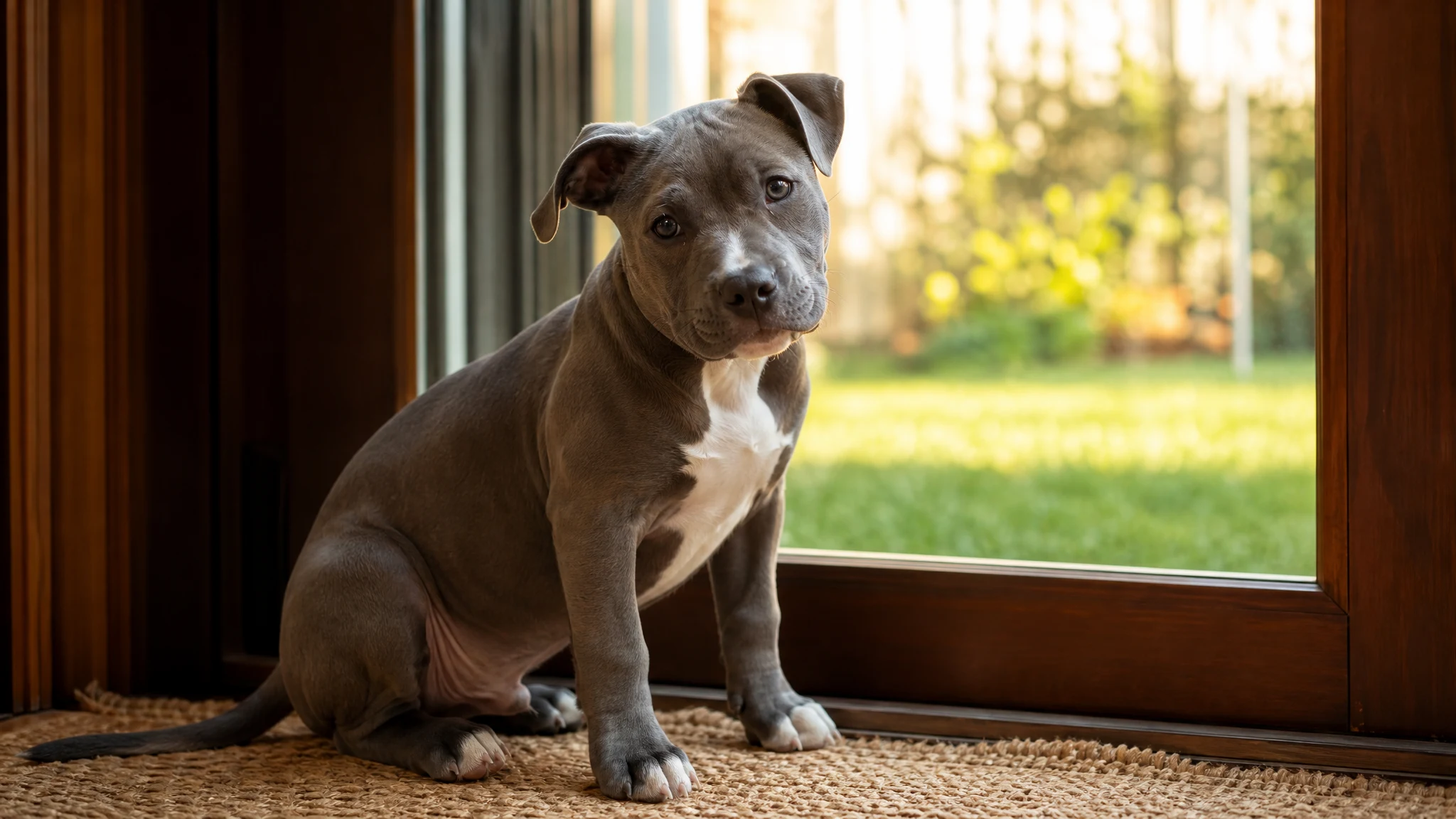
General training information. Every dog is an individual; for health or behavior concerns, see your veterinarian.
Learning how to potty train an American Pit Bull Terrier puppy comes down to three things: a predictable schedule, close supervision, and rewards for getting it right. The breed is muscular and agile, and the United Kennel Club (UKC) breed standard describes it as eager to please. That is a good start for house training. Your job is to make the right answer easy and worth repeating.
This guide gives you a simple plan you can start the day your puppy comes home. Every puppy is different, so treat the timing as a guide and adjust to your own dog.
What American Pit Bull Terrier potty training looks like
House training is not about the puppy understanding the rules. It is about building a habit. The puppy goes in one spot outside, gets paid for it, and learns that this spot is where relief happens.
The UKC standard says the breed does best with an owner who carefully socializes and obedience trains it. Potty training is your first obedience lesson. The routines you set now (calm, consistent, reward-based) carry straight into sit, down and walking nicely on a leash later.
The UKC also lists mature males at 35 to 60 pounds and mature females at 30 to 50 pounds. Your puppy will grow into a strong dog. A habit that is a small nuisance at ten pounds is a bigger problem at fifty, so it pays to get this right early.
What you need
Gather these before the puppy arrives:
- A crate sized so the puppy can stand, turn around and lie down. Too much extra room makes it easier to use one corner as a bathroom.
- Small, soft treats that the puppy can swallow fast. Pea-sized pieces work well. Ask your veterinarian how treats fit into the daily food plan.
- A leash and a flat or harness-style setup for trips outside, so the puppy cannot dash off.
- An enzyme-based cleaner made for pet accidents. Ordinary cleaners may leave a scent that draws the puppy back to the same spot.
- A gate or exercise pen to keep the puppy in a small, supervised area.
- A notebook or phone notes to log meals, naps, trips outside and accidents.
- Paper towels and patience. You will use both.
Step-by-step: house training an American Pit Bull Terrier
Step 1: Pick one potty spot and one cue word
Choose a patch of yard or a spot near your door. Carry the puppy there at first if needed, then walk on leash. Stand still and stay quiet and boring. When the puppy starts to go, say your cue word softly, such as "go potty." Say it once or twice, not over and over.
Using the same spot every time helps the puppy link the smell and the surface with the job.
Step 2: Build a schedule around the puppy's body
Puppies usually need to go at predictable moments. Plan trips outside:
- First thing in the morning, before anything else
- Right after meals
- Right after waking from any nap
- After play sessions or excited greetings
- Before bed, and again if the puppy wakes at night
- Every so often in between, as often as your puppy needs
Very young puppies need a lot of trips, sometimes every hour or two while awake. How long a puppy can comfortably wait depends on age, size and the individual dog. Your veterinarian can give you a realistic starting range for your puppy. If you are unsure, go out more often, not less.
Feed at set times rather than leaving food out all day. Regular meals tend to lead to more regular potty trips, which makes the schedule easier to predict.
Step 3: Go out with the puppy every time
Do not just open the door and wait inside. Walk out on leash so you can see the puppy go and reward it at once. If you stay inside, you cannot reward the right moment, and a distracted puppy may come in and have an accident on the rug.
Give the puppy a few minutes. If nothing happens, go back in, keep the puppy close or crated for a short time, and try again soon.
Step 4: Reward right away
The instant the puppy finishes, praise warmly and give a treat. Timing matters. A reward that arrives after the puppy runs back to the door teaches nothing about the potty spot.
Do the treat and praise first. Play or a walk can come second, as an extra reward. If a trip outside always ends the fun, some puppies learn to hold it in and stall. Let the reward be good news.
Step 5: Use the crate as a rest spot, not a punishment
Most puppies do not like to soil the place where they sleep, which is why a properly sized crate helps. Make it comfortable. Feed some meals there, toss treats in, and never use it as a place to send the puppy when you are annoyed.
Use the crate for naps and for times you cannot watch the puppy. Take the puppy straight outside when it comes out. Do not leave a puppy crated longer than it can reasonably hold its bladder, and do not rely on the crate for long stretches. If you have to be away for hours, ask your veterinarian or a trainer about a plan, such as a safe pen setup or a midday helper.
Step 6: Supervise when the puppy is loose
When the puppy is out of the crate, keep it in sight. A tether to your waist, a closed door or a gated room all work. Watch for the signs: sniffing the floor, circling, wandering off, or suddenly going quiet.
If you see those signs, calmly pick up the puppy or clip on the leash and head out. Praise and reward if it finishes outside.
Step 7: Handle accidents without punishment
Accidents will happen. Stay calm.
- If you catch the puppy in the act, make a small, neutral noise to interrupt, then carry the puppy outside. Reward if it finishes there.
- If you find the mess later, just clean it up. The puppy cannot connect a scolding to something that happened minutes ago.
- Clean the spot with an enzyme-based cleaner.
- Write it down, then ask what you missed. Was a trip late? Was the puppy unsupervised?
Reward-based training is the approach supported by the American Veterinary Society of Animal Behavior (AVSAB). Yelling, rubbing a nose in a mess or other harsh methods can make a puppy fearful of going in front of you. That often leads to sneaking off to pee behind the couch, which is the opposite of what you want.
Step 8: Stretch the time slowly
After several days with few or no accidents, add a little time between trips. If accidents come back, go back a step. Progress is rarely a straight line. Growth spurts, new places, teething and big changes at home can all cause slips.
Over the weeks, begin to let the puppy have more room in the house, one room at a time. Keep supervising until it has had a long run of clean days.
Breed-specific notes
Most of what matters in house training is the same for any puppy. A few points tie into what breed sources say about the American Pit Bull Terrier.
Eager to please, so use it
The UKC describes the breed as eager to please, with strength, confidence and a zest for life. In practice, many puppies of this type respond well to clear, upbeat rewards. An article from the American Dog Breeders Association (ADBA) quotes a behaviorist praising the breed's trainability. That does not mean every puppy learns fast. It means a patient, positive plan is likely to be well received.
Excitement can undo your plan
The UKC calls this a very friendly breed, even with strangers. A puppy that greets every visitor with a wiggling, wild welcome may also pee from excitement. Keep greetings low-key, take the puppy out before guests arrive, and ask visitors to wait for calm before petting. If this continues past the early months, your veterinarian can check there is no medical cause.
Strong and athletic means secure and supervised
The UKC describes a powerful, agile dog and notes the breed is a strong climber, so secure fencing is needed. For potty training, that means a leash for every trip outside until you are sure of the fence and the puppy's recall. A puppy that bolts to chase something is not learning to go in one spot.
Socialize while you house train
The ADBA article on early puppy socialization says the key window runs from eight weeks to six months of age, and that calm early exposure builds confidence. Your potty trips are a natural time to practice. Let the puppy see new surfaces and sounds from a comfortable distance, and reward calm behavior. Check with your veterinarian about when and where it is safe for your puppy to be out in public before vaccines are complete.
The UKC also notes that most American Pit Bull Terriers show some level of dog aggression, so careful, planned socialization is part of ownership. Keep potty breaks away from unknown dogs, and ask a qualified trainer for help if you have concerns.
Bladder size, stubbornness and sensitivity
The breed sources used here do not give figures for bladder capacity, and they do not label the breed as stubborn or sensitive. Individual dogs vary. Some puppies learn quickly, some are easily distracted, and some are more worried by a firm tone. Watch your puppy, adjust the pace, and ask your veterinarian how long your puppy can reasonably wait at its age.
Tips for faster progress
- Keep the schedule boring and steady. Same times, same spot, same words.
- Take the puppy out before you think it needs to go. Prevention beats correction.
- Carry treats in your pocket so the reward is never late.
- Limit water close to bedtime only if your veterinarian says that is appropriate for your puppy. Do not restrict water on your own.
- Use the same door each time, so the puppy learns where to go.
- Share the plan with everyone in the home, so every person follows the same routine.
Common mistakes to avoid
- Punishing accidents. It can teach the puppy to hide, not to go outside.
- Giving too much freedom too soon. A big open house is a lot of potential bathroom.
- Staying inside while the puppy goes out alone. You cannot reward what you do not see.
- Skipping the post-meal and post-nap trip. These are the most predictable moments of the day.
- Cleaning with ordinary products. Leftover scent can invite repeat accidents.
- Treating the crate as a jail. It should be a calm, comfortable place.
- Changing the plan every few days. Pick a routine and give it time.
- Ending outside time right after the puppy goes. Reward first, then play.
What to expect and how long it takes
There is no single timeline. Many puppies start to catch on within a few weeks of a consistent routine, and many take a few months to be reliable. Some have slips well after that, especially during stressful changes. The breed sources used for this article do not give a house training timeline, so treat any number you see online as a rough guess.
With steady effort, you can reasonably expect:
- Fewer accidents over the first weeks as the puppy learns the routine
- The puppy starting to go to the door or wait for you as it understands the pattern
- Longer stretches between trips as the puppy matures
- Occasional setbacks that settle with a return to the basics
Results vary with age, health and consistency at home. If your puppy seems to need to go very often, strains, or has a sudden change in habits, call your veterinarian. Health questions belong with them, not with a training plan.
A simple daily plan to start with
- Wake up and go straight outside on leash. Reward.
- Breakfast, then another trip outside. Reward.
- Supervised play, then outside. Reward.
- Nap in the crate, then straight outside. Reward.
- Repeat through the day, around each meal, nap and play session.
- Last trip outside before bed, then the crate for the night.
- Write down any accidents and adjust the next day's schedule.
Stick with it for a few weeks before judging how well it works. A calm, repeatable routine is the heart of American Pit Bull Terrier potty training, and it sets you up well for the more advanced training to come.